Crochet Green Heart Door Curtain Pattern: A Free Strand Curtain for Doorways and Windows
Crochet Pattern · Home Décor · Easy
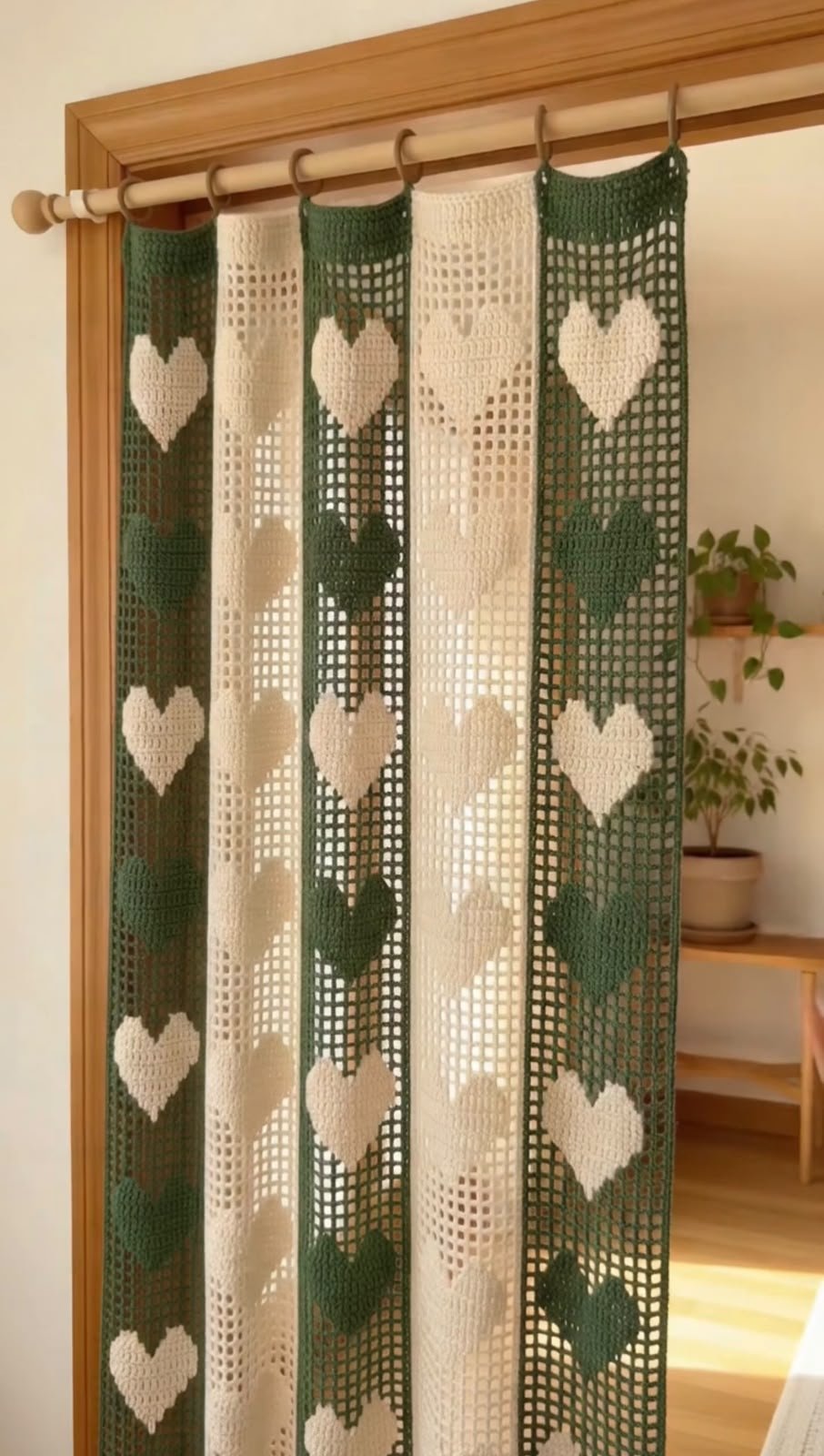
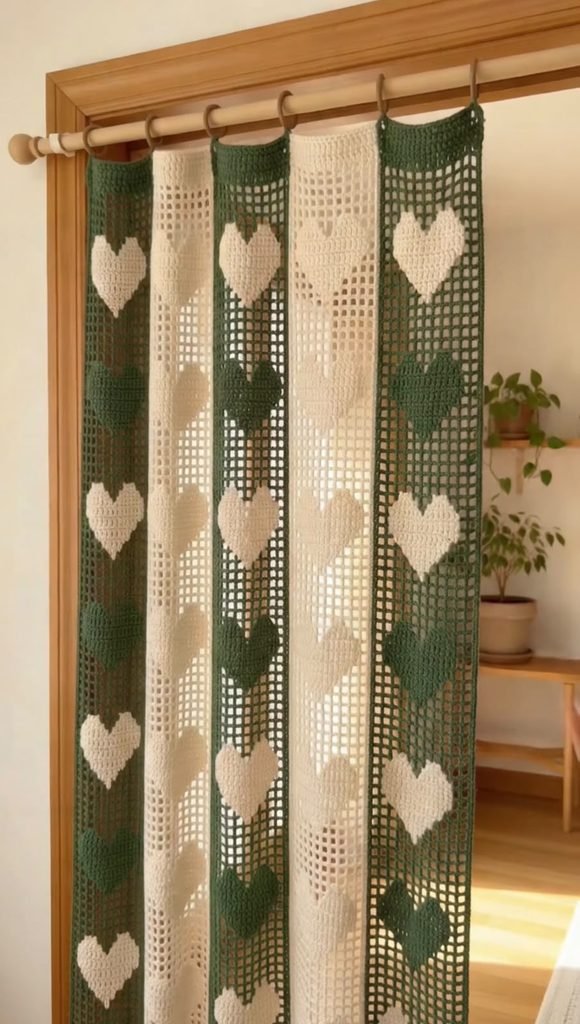
A crochet green heart door curtain turns an ordinary doorway into a cascade of emerald hearts that sway and shimmer with every step. Each strand carries a staggered column of small, flat hearts. Together they form a soft, rustling screen that filters light, marks a threshold, and looks far more expensive than the cost of a few skeins of cotton.
This pattern builds the curtain from one simple motif repeated 85 times. Every heart is worked flat in single crochet, starting at the bottom point and splitting into two rounded lobes at the top. The hearts are sewn to long chain spines, which are tied to a wooden dowel. You can work a few hearts in front of the TV and assemble the whole curtain over a weekend, because the motif is easy to memorize and every heart is identical.
The finished curtain is 79 cm (31 in) wide and 185 cm (73 in) long. That suits a standard bedroom, closet, or balcony doorway, and it is just as pretty hung in a window. Choose a deep emerald for a jewel-toned boho look, or move to sage, mint, or forest green for a different mood. A mix of green shades or an ombré gradient from dark at the top to light at the bottom is another good option. Hang it in a nursery, a plant corner, a craft room, a dorm, or a Valentine’s or Saint Patrick’s Day display. It also makes a thoughtful housewarming gift.
Because the hearts are staggered between neighboring strands, they never collide, and the curtain keeps a layered, floating look. Cotton gives each heart a crisp edge and enough weight to hang straight, and it is also easy to wash. If you love handmade boho décor, a crochet heart garland, or crochet room décor with a statement, this pattern delivers all three in one project.
Pattern at a Glance
| Detail | Information |
|---|---|
| Skill Level | Easy |
| Finished Size | 79 cm wide × 185 cm long (31 in × 73 in); each heart approximately 6.5 cm × 5 cm (2.5 in × 2 in) |
| Time to Complete | Approximately 22 to 28 hours |
| Hook Size | 3.0 mm |
| Yarn Weight | DK (light worsted, category 3), 100% cotton |
| Number of Pieces | 85 hearts, 10 chain spines, 1 wooden dowel |
Skill Level
Easy. The pattern uses only single crochet, simple increases and decreases, and basic chains, so it suits confident beginners. The hearts are small enough that mistakes cost very little. The only real challenge is stamina, since you will repeat the same motif many times.
Techniques used:
- Chain and slip stitch
- Single crochet in flat, turned rows
- Increasing (two single crochets in one stitch)
- Decreasing (single crochet two together)
- Joining new yarn at a specific stitch
- Whipstitch sewing with a yarn needle
- Wet blocking
- Tying a secure knot around a dowel
Finished Size
- Curtain width: approximately 79 cm (31 in), including the width of the outer hearts
- Curtain length: approximately 185 cm (73 in) from dowel to the bottom of the spines
- Heart: approximately 6.5 cm wide × 5 cm tall (2.5 in × 2 in)
- Dowel: 80 cm (31½ in) long
Size changes with yarn weight, hook size, and tension. A looser tension or a 3.5 mm hook makes larger, floppier hearts. Worsted weight cotton on a 3.5 mm hook gives hearts of roughly 8 cm, and you would then need to widen the strand spacing. Heavier hearts also stretch the chain spines slightly, so always measure the spines flat rather than relying on stitch counts alone.
Gauge
Approximately 22 single crochet stitches and 24 rows equal 10 cm (4 in) with a 3.0 mm hook. Consistent tension matters more than an exact swatch, because every heart needs to match its neighbors. Work firmly enough that the fabric feels dense, with no gaps between stitches. If your hearts come out noticeably larger than 6.5 cm wide, drop a hook size. If they feel stiff and curl at the edges, go up half a size.
Yarn Requirements
| Item | Color | Approximate Amount |
|---|---|---|
| Hearts (85) | Emerald Green | Approximately 225 yd (205 m) |
| Chain spines and knot tails (10) | Emerald Green | Approximately 50 yd (45 m) |
| Spare for tails and mistakes | Emerald Green | Approximately 25 yd (23 m) |
| Project total | Emerald Green | Approximately 300 yd (275 m), about 125 g |
Three 50 g skeins of DK cotton are enough, with a small amount left over. Buy all your yarn from the same dye lot, since green cotton can vary noticeably between batches.
Materials
- 3.0 mm crochet hook
- DK weight 100% cotton yarn in Emerald Green (see the table above)
- 1 smooth wooden dowel, 80 cm long and approximately 1.5 cm in diameter
- Jute twine or strong cord, approximately 60 cm, for hanging the dowel
- 2 adhesive wall hooks or screw-in cup hooks, rated for light loads
- Yarn needle with a large eye
- Scissors
- Tape measure
- T-pins and a blocking mat or folded towel
- Dressmaker pins, for marking heart positions along each spine
- Spray bottle with water
Safety note: This curtain contains long cords and strands. Do not hang it where infants, toddlers, or pets can reach it, since loose strands can pose a strangulation hazard. It is also not a toy. Check the knots on the dowel occasionally.
Abbreviations (US Terms)
| Abbreviation | Meaning |
|---|---|
| ch | chain |
| sl st | slip stitch |
| sc | single crochet |
| inc | increase (2 sc in the same stitch) |
| dec | decrease (sc2tog: single crochet 2 stitches together) |
| st(s) | stitch(es) |
Notes Before You Begin
- Row style: Every heart is worked flat in turned rows. Turn your work at the end of each row. The turning chain (ch 1) does not count as a stitch.
- Stitch counts: The number in parentheses at the end of each row is your total stitch count for that row. Check it as you work, because the heart shape depends on it.
- Starting tail: Leave a 15 cm (6 in) tail when you begin each heart. You will use it to sew the heart’s point to the spine.
- Counting stitches: In Row 6, count the 13 stitches from left to right. Stitch 7 is the center stitch, left unworked as the dip between the lobes.
- Working the lobes: The right lobe uses the same yarn that you used for the body. The left lobe needs fresh yarn joined in the center stitch.
- Production tip: Make all 85 hearts first, then block them together, then assemble.
- Yarn color: Use one color throughout, or alternate shades if you want a gradient. Keep your colorway plan consistent before you start.
- Spacing: The curtain has 10 strands. Strands 1, 3, 5, 7, and 9 carry 9 hearts each. Strands 2, 4, 6, 8, and 10 carry 8 hearts each. That makes 45 + 40 = 85 hearts in total.
Complete Pattern
Heart Motif (Make 85)
Purpose: The decorative element of the curtain.
Color: Emerald Green.
Starting method: Chain 2, leaving a 15 cm starting tail.
Row 1: ch 2, 3 sc in the 2nd ch from hook. (3)
Row 2: ch 1, turn, inc, 1 sc, inc. (5)
Row 3: ch 1, turn, inc, 3 sc, inc. (7)
Row 4: ch 1, turn, inc, 5 sc, inc. (9)
Row 5: ch 1, turn, inc, 7 sc, inc. (11)
Row 6: ch 1, turn, inc, 9 sc, inc. (13)
Right lobe (uses the stitches on the right-hand side of Row 6, stitches 8 to 13). Leave stitches 1 to 7 unworked.
Row 7: ch 1, turn, inc in the first st, 5 sc. (7)
Row 8: ch 1, turn, 7 sc. (7)
Row 9: ch 1, turn, dec, 5 sc. (6)
Row 10: ch 1, turn, 4 sc, dec. (5)
Row 11: ch 1, turn, dec, 3 sc. (4)
Fasten off and weave in the end.
Left lobe (uses stitches 1 to 6 of Row 6, with the center stitch used as the anchor for joining).
Hold the heart so the same side faces you as when you began the right lobe. Join fresh yarn with a sl st in stitch 7 of Row 6 (the center stitch), leaving a 15 cm tail at the join. You will use this tail to sew the heart’s dip to the spine.
Row 7: ch 1, 5 sc in stitches 6 to 2, inc in stitch 1. (7)
Row 8: ch 1, turn, 7 sc. (7)
Row 9: ch 1, turn, 5 sc, dec. (6)
Row 10: ch 1, turn, dec, 4 sc. (5)
Row 11: ch 1, turn, 3 sc, dec. (4)
Fasten off and weave in the end.
Stitch-count check: Rows 1 to 6 contain 3 + 5 + 7 + 9 + 11 + 13 = 48 stitches. Each lobe contains 7 + 7 + 6 + 5 + 4 = 29 stitches, so two lobes make 58. Total: 106 single crochets per heart.
Blocking: Pin each heart flat with T-pins, with the point straight and the lobes rounded. Mist with water and let it dry completely. Blocking evens out the edges and makes the lobes look smooth.
Strand Spine (Make 10)
Purpose: The vertical chain that carries the hearts.
Color: Emerald Green.
Quantity: Make 10.
Starting method: Slip knot, leaving a 40 cm starting tail for tying to the dowel.
Ch approximately 310, or until the chain measures 190 cm (75 in) when laid flat and relaxed. Do not stretch the chain. Fasten off, leaving a 15 cm tail, and tie a small knot at the end to keep the chain from unraveling.
Marking heart positions: Mark positions from the knotted top of the spine, after allowing 5 cm for the dowel knot.
- Strands 1, 3, 5, 7, 9 (9 hearts each): Place the first heart’s dip 15 cm below the dowel, then every 20 cm (at 15, 35, 55, 75, 95, 115, 135, 155, and 175 cm). The last heart’s point lands at 180 cm.
- Strands 2, 4, 6, 8, 10 (8 hearts each): Place the first heart’s dip 25 cm below the dowel, then every 20 cm (at 25, 45, 65, 85, 105, 125, 145, and 165 cm). The last heart’s point lands at 170 cm.
Use a dressmaker pin at each dip position. Staggering the heights between neighboring strands keeps the hearts from bumping and gives the curtain its layered look.
Hanging Rod Setup
Purpose: The support for the whole curtain.
Materials: 80 cm dowel, jute twine, 2 wall hooks.
- Cut the jute twine in half so you have two 30 cm lengths.
- Tie one length around each end of the dowel, 3 cm in from the end, and knot it securely. Tie each into a loop approximately 10 cm tall.
- Mark the positions for the 10 strands along the dowel. Place the first at 4 cm from the left end, then every 8 cm (at 4, 12, 20, 28, 36, 44, 52, 60, 68, and 76 cm).
- Install the two wall hooks above the door frame, 80 cm apart, so the dowel loops can hang from them. Check that the bottom of the curtain will clear the floor by at least 10 cm.
Assembly, Styling, and Stability
Recommended assembly order:
- Block all 85 hearts and let them dry completely.
- Make the 10 spines and mark the heart positions with pins.
- Tie each spine to the dowel with its starting tail, wrapping twice around the dowel and finishing with two square knots. Trim the tail to 3 cm.
- Hang the dowel from the wall hooks, or rest it on a table with the spines laid out straight.
- Starting with the top heart on each strand, sew each heart to the spine. Thread the dip tail onto your yarn needle, then pass it through the center stitch and around the spine with 2 small whipstitches. Repeat at the point with the starting tail. Work each strand from top to bottom, so the weight of the hearts is applied gradually.
- Check the staggering. Odd strands should start at 15 cm and even strands at 25 cm.
- Weave in all loose ends and trim.
Heart alignment: Each heart should hang straight, with the point down and the dip at the top. The center of the heart should sit exactly over the spine. If the heart looks like it is leaning, redo the stitches.
Stability: The weight of the cotton hearts keeps the strands hanging straight. If the strands twist, they usually need a slightly tighter tension at the sewing points. Hang the curtain in a draft-free spot, since a strong draft can tangle the strands.
Styling: For the best look, leave about 1.5 cm between neighboring hearts. Run your fingers down each strand once after hanging, so the hearts settle in position.
Final Finishing Checklist
- ✅ All 85 hearts have 106 stitches and a clear, well-defined dip at the top
- ✅ Hearts are blocked flat with a straight point and rounded lobes
- ✅ Every heart is sewn at both the dip and the point
- ✅ Odd strands have 9 hearts and even strands have 8
- ✅ Odd strands start at 15 cm and even strands at 25 cm below the dowel
- ✅ All 10 spines are tied securely to the dowel
- ✅ Spacing between strands is even at 8 cm
- ✅ All yarn ends are woven in or trimmed neatly
- ✅ The dowel hangs level and the curtain clears the floor
- ✅ The curtain hangs out of reach of babies and pets
Pro Tips
💡 Make hearts in batches of 10. It keeps the count manageable and helps you build a steady rhythm.
💡 Count Row 6 twice. The 13 stitches decide where the dip sits. If you miscount, the lobes will be uneven.
💡 Join the left lobe in stitch 7 firmly. A loose join leaves a visible gap at the dip.
💡 Block every heart. Unblocked hearts curl at the edges and look uneven when hung.
💡 Measure the spines flat. Chains stretch when hanging, so lay each one on a table before marking positions.
💡 Use pins for position marks. They are quick to move if you decide to change your spacing.
💡 Work from top to bottom when sewing. The strand stays straight and the weight is applied gradually.
💡 Hang a trial strand first. Test one strand with a few hearts to check the drape before committing to all 10.
Care Instructions
- Washing: Hand wash in cool water with mild soap. Do not wring. Gently squeeze out the water.
- Colorfastness: Dark greens can bleed. Wash separately, and avoid pairing with pale cottons.
- Drying: Lay flat or hang on a drying rack until completely dry. Reshape the hearts with your fingers.
- Machine washing: Not recommended, because the strands will tangle.
- Sun exposure: Direct sun can fade cotton over time. Hang away from strong afternoon sun if possible.
- Storage: Roll the curtain loosely around the dowel and keep it in a breathable bag.
Frequently Asked Questions
How many hearts do I need for a crochet door curtain?
This pattern uses 85 hearts across 10 strands: 45 hearts on the odd strands and 40 on the even strands.
Can I use worsted weight yarn instead of DK?
Yes. Use a 3.5 mm hook. The hearts will be larger (approximately 8 cm wide), so widen the strand spacing to 10 cm and reduce the strand count to 8.
What hook size is best for crochet hearts?
A 3.0 mm hook with DK cotton gives firm hearts with a clean shape. A larger hook makes floppier hearts that curl.
How do I stop the strands from tangling?
Stagger the heart heights, keep spacing even, and hang the curtain away from drafts.
Is this pattern good for beginners?
Yes. It uses only single crochet, increases, and decreases, and every heart is identical.
Can I hang this in a window instead of a doorway?
Yes. Shorten the spines to suit the window, and reduce the number of hearts per strand.
Final Thoughts
There is something quietly satisfying about watching a pile of small green hearts grow into a flowing curtain. Each heart is a small win, and together they transform a plain doorway into something personal and handmade. Whether you hang it in your own home or give it as a gift, it will catch the light and draw smiles.
Try an ombré from dark forest green to pale mint, or swap in red hearts for a Valentine’s version. You could also make the strands shorter and hang the curtain in a window. Take a photo once it is up, and share it with other makers who might be inspired.
Which shade of green would you choose for your crochet green heart door curtain, and where will it hang first?